The Rise of the Mid-Career Sabbatical: Why More Professionals Are Stepping Away From Work
In a recent article in The Irish Times, I was asked about a trend that has become increasingly visible in my work as a career coach: more professionals in their thirties, forties and fifties are stepping away from their careers for a period of time.
Sometimes it is a few months. Sometimes a year. Occasionally it becomes something longer and more transformative.
What used to be framed as a “midlife crisis” is increasingly being reframed as something far more intentional: a mid-career sabbatical. People who have spent decades building their professional lives are beginning to pause and ask deeper questions about what the next stage of those lives should look like.
Behind these decisions there is rarely a single dramatic moment. More often, it is the gradual realisation that the career path which once felt like a natural progression now feels less certain. The work may still be stable and financially secure, but the sense of meaning that once accompanied it has quietly diminished.
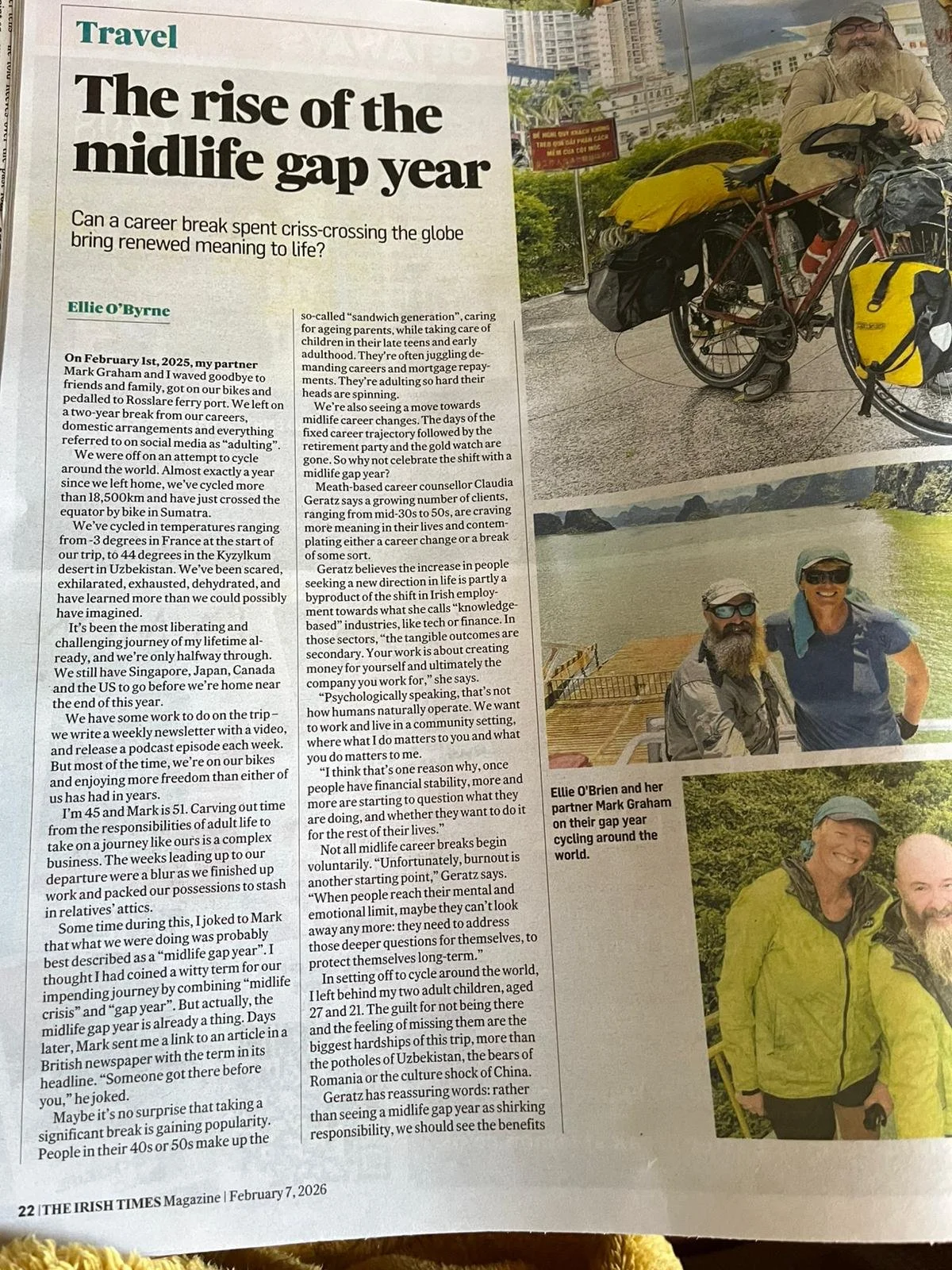
My interview on mid-life career changes in The Irish Times
As I explained in The Irish Times, once people reach a level of financial stability, a new kind of questioning often emerges.
“Once people have financial stability, more and more are starting to question what they are doing, and whether they want to do it for the rest of their lives.”
This question tends to appear most strongly in the middle decades of life, when the early momentum of career building has slowed and the horizon of the future becomes easier to see. Professionals who once focused on promotion, salary increases or establishing themselves in their industry may suddenly find themselves wondering what all that effort has ultimately been in service of.
For many, this moment is less about dissatisfaction with their work and more about a desire to reconnect with something deeper: purpose, contribution, or a sense that the work they do has a tangible impact on the world around them.
The Changing Nature of Work
Part of what is driving this shift is the changing nature of the modern workplace. Over the past two decades, Ireland’s economy has increasingly moved toward knowledge-based industries such as technology, finance, consulting and other professional services. These sectors offer highly skilled and often well-paid roles, yet they can also create a certain psychological distance between effort and outcome.
As I noted in the interview, many of these roles involve generating value in ways that are difficult to see or feel directly.
“The tangible outcomes are secondary. Your work is about creating money for yourself and ultimately the company you work for.” I explained.
From a psychological perspective, that dynamic can create a subtle tension. Human beings evolved in communities where our work had visible consequences for the people around us. We could see the results of our efforts, whether through building, growing, teaching, caring or creating something tangible.
Modern professional work, by contrast, can sometimes feel abstract. The spreadsheets, reports and strategy documents that occupy much of our working lives may contribute to enormous economic value, yet they do not always satisfy the deeper human need to feel that what we do genuinely matters to others.
Over time, that gap can lead people to reassess the role that work plays in their lives.
When Burnout Forces the Question
Not every mid-career break begins as a deliberate life experiment. In many cases, the catalyst is burnout.
Professionals who have spent years operating at a relentless pace—balancing demanding roles with family responsibilities, mortgages and the everyday logistics of adult life—may eventually reach a point where the emotional and psychological strain becomes impossible to ignore.
As I explained in the article:
“When people reach their mental and emotional limit, maybe they can’t look away any more. They need to address those deeper questions for themselves to protect their long-term wellbeing.”
Burnout often acts as a signal rather than a failure. It forces a pause in a system that rarely allows one. And once people begin to step back, even slightly, they often realise how little space they had previously given themselves to think about the direction of their lives.
This is where the idea of a mid-career sabbatical begins to emerge—not as an escape from responsibility, but as a deliberate attempt to create the conditions for reflection.
Stepping Off the Hamster Wheel
Modern professional life is structured in a way that makes reflection surprisingly difficult. Most people move from one milestone to the next—degree, first job, promotion, mortgage, family—without ever having a natural point at which to pause and reassess the broader trajectory of their career.
In coaching conversations, I often describe this as the “hamster wheel” of working life: once you are running, it becomes extremely difficult to slow down long enough to see the bigger picture.
A career break, even a relatively short one, can offer that perspective.
As I said in the interview:
“Only when people get a chance to step away from the hamster wheel do they get a chance to see what is really going on in the world.”
When people step away from the intensity of their daily routines, they frequently rediscover parts of themselves that had been pushed aside by years of professional pressure: curiosity, creativity, and a desire to contribute in ways that feel more aligned with their values.
For some, this leads to a career change. For others, it simply leads to a redesigned relationship with their existing work. Either outcome can be transformative.
A Career Break Doesn’t Have to Be Dramatic
The stories that often make headlines—cycling across continents, sailing around the world, or embarking on multi-year adventures—represent only one version of what a mid-career sabbatical can look like.
In reality, many career breaks are far quieter.
Some people take several months to travel slowly or spend time in nature. Others use the time to retrain, explore a new field, volunteer, or simply recover from years of chronic stress. Many use the space to experiment with ideas that might eventually develop into a different kind of career.
What matters is not the scale of the break but the opportunity it creates.
A sabbatical allows people to step outside the assumptions that have shaped their working lives and to ask a more fundamental question: What kind of work do I want to spend the next decade doing?
Imagining a Different Culture of Work
Looking ahead, it may be time to reconsider how we structure careers more broadly.
In the article, I suggested that career breaks could eventually become a more normal part of working life, supported by both employers and public policy. Initiatives such as Ireland’s Universal Basic Income for the Arts demonstrate that society is capable of experimenting with new ways of supporting creative and meaningful work.
It is not difficult to imagine a future where structured sabbaticals become a recognised stage of professional life, giving people the opportunity to periodically reflect, retrain or redirect their careers. Rather than seeing such breaks as indulgent or irresponsible, we might come to view them as investments—both in individual wellbeing and in the long-term creativity and resilience of our workforce. People who have taken the time to reconnect with their values often return to work with renewed clarity, energy and purpose.
Rethinking the Next Chapter of Your Career
If you have found yourself wondering whether the work you do still feels meaningful, you are far from alone. Many mid-career professionals reach a point where they realise that the path they began in their twenties may not be the path they want to continue indefinitely. That realisation is not necessarily a problem to be solved. Often, it is the beginning of an important conversation with yourself about what the next chapter of your career could look like.
Sometimes that chapter involves a career break. Sometimes it involves a gradual shift toward work that feels more purposeful. And sometimes it simply begins with the act of stepping back long enough to think clearly about what you want.
If you are currently reflecting on your own career direction, you can learn more about my coaching work or book a free exploratory conversation here.
For many people, the first step toward change is simply creating space to ask the right questions.